Logo 1 1

Sharjah Census 2025

About the Project

The Sharjah Census 2025 is implemented under the direct guidance of His Highness Sheikh Dr. Sultan bin Mohammed Al Qasimi, Member of the Supreme Council and Ruler of Sharjah. It reflects His Highness’s vision to establish a reliable statistical foundation that supports social, economic, and developmental planning across the Emirate. The project is supervised by the Department of Statistics and Community Development and officially approved by the Sharjah Executive Council, making it the most comprehensive and up-to-date source of demographic and housing data for the Emirate. The census aims to build a robust knowledge base to assist policymakers in formulating evidence-based strategies and shaping Sharjah’s future through accurate and integrated information.


Implementation Timeline

Phase 1 – Telephone Interviews: From 15 October 2025 to 31 December 2025, data will be collected and updated through DSCD’s official call center.

Phase 2 – Field Interviews: From 3 November 2025 until the end of 2025, limited in-person field visits will be conducted for households that could not be reached by phone, ensuring comprehensive coverage of all families in the Emirate.


Data Collection Methods

The census utilizes multiple, advanced data collection methods to ensure accuracy and completeness:

Telephone Interviews: Conducted through the official Census Call Center at 065020202, where trained enumerators collect and update household data securely and confidentially.

Field Interviews: Conducted by accredited DSCD field staff following official procedures and strict quality standards.


Administrative Government Records: Used as a data source for non-Emirati households, processed using advanced statistical methodologies to generate population estimates based on previous census data and validated administrative sources.


Data Confidentiality and Privacy

DSCD affirms that all collected information is used solely for statistical purposes and is not shared with any external entity. All data are processed under the highest national and international standards of data protection and confidentiality, in compliance with federal and local statistical laws and regulations. To ensure participant safety and trust, DSCD emphasizes that:

  • No official documents or ID copies will ever be requested.
  • No bank account details or financial information will be requested.
  • No electronic links will be sent via text messages or social media platforms.
  • Any links or messages not issued through DSCD’s official channels are considered unofficial and potentially fraudulent.


If You Doubt the Caller’s Identity:

  • You may contact the Department of Statistics and Community Development directly to verify the identity of the enumerator.
  • Kindly request the enumerator’s full name and employee ID number, and you may also ask to speak with a Census Supervisor to confirm that the call originates from the official census team.
  • For assistance, contact the official call center at 065020202 or email [email protected]


Census Call Center Working Hours

Sunday to Thursday

9:00 a.m. to 5:00 p.m.

During the census period only (15 October – 31 December 2025)


Contact and Inquiries

For inquiries or to verify the authenticity of a call, please contact the Department of Statistics and Community Development via:

Email: [email protected]

Official Call Center: 065020202

WhatsApp: 0509000391

Official Website: dscd.ae


Objectives of the Census

  • To establish a comprehensive and updated database of the population and housing in the Emirate of Sharjah.
  • To support developmental, social, and economic planning and policy formulation.
  • To measure key indicators of human development and quality of life across the Emirate.
  • To produce accurate and reliable population estimates to support decision-making.
  • To assess the living conditions of specific social groups that require special attention, helping guide targeted social and developmental programs.


How to Prepare for the Census

  • Keep the Emirates ID numbers of all family members ready before you receive a call from the Census Call Center, to shorten the interview time and ensure accuracy.
  • Cooperate fully with the enumerator when receiving an official call from 065020202.
  • Ignore any calls or messages from unofficial numbers.
  • Provide accurate and truthful information, as every data point contributes to decisions that enhance your community’s quality of life and the Emirate’s sustainable development.


Census Message

“Sharjah Census 2025… You Count, and Your Data Matters — Delivered to the Decision Makers of the Emirate.”

Rectangle 8

Sharjah Censuses

The Department of Statistics and Community Development in Sharjah conducts comprehensive population censuses every five years, following a sustainable statistical approach aimed at producing accurate and up-to-date data to support development planning. The first comprehensive census was conducted in 2015, followed by Sharjah Census 2022, and the 2025 Census is currently underway using an advanced dual methodology.

This approach includes direct data collection through field interviews, telephone surveys, and electronic self-enumeration, in addition to partial reliance on administrative records and big data available from government entities. This ensures complete coverage and high data accuracy across all areas of the Emirate. The Department is moving towards fully administrative-based censuses starting in 2030, aiming to establish a continuous annual population data system that provides integrated demographic, social, and economic statistics.

Key Census Outputs:

  • Detailed data on population size and distribution by gender, age, and nationality.
  • Information on households, housing units, buildings, and establishments, including spatial characteristics.
  • Indicators on education, employment status, and economic activities.
  • Data on housing patterns and population mobility within the Emirate.
  • Statistical maps and spatial data illustrating population and geographic distribution with high precision.

Census results form a comprehensive statistical foundation for developing annual population estimates and guiding evidence-based policy and planning efforts in the Emirate of Sharjah.
Rectangle 9

Statistical Surveys

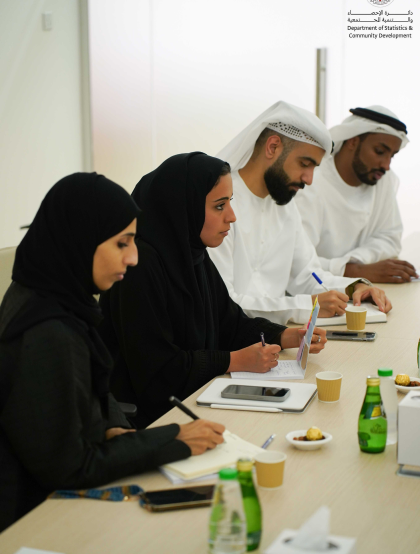
The Department of Statistics and Community Development in Sharjah conducts a range of periodic and specialized surveys designed to collect accurate and comprehensive data covering various demographic, social, economic, educational, and safety dimensions across the Emirate. These surveys play a key role in supporting development planning, shaping public policy, and providing reliable indicators that reflect Sharjah’s current realities and future aspirations.

Below are the main surveys and opinion polls conducted by the Department:

  • Comprehensive Survey of Emirati Households: Examines the social and economic characteristics and developmental needs of Emirati families.
  • Vulnerable Groups Survey: Focuses on population groups receiving special attention from the Government of Sharjah, such as widows, divorced women, orphans, the elderly, and persons with disabilities, to assess their social and economic conditions and needs.
  • Education Survey: Measures the cost of educational services according to the type and level of curriculum.
  • Research and Development Survey: Monitors research and innovation activities in both government and private institutions.
  • Labour Force Survey: Measures the size of the labour force, employment and unemployment rates, and skill levels.
  • Annual Economic Survey: Collects detailed data on business activities and establishments and their contribution to Sharjah’s GDP.
  • Rent Survey: Studies trends and levels of residential and commercial rental prices across the Emirate.
  • Commercial Farms Survey: Examines agricultural production and modern commercial farming practices.
  • Foreign Investment Survey: Tracks direct and indirect foreign investment inflows into the Emirate.
  • Trade in Services Survey: Measures the volume and nature of services exchanged between Sharjah and international markets, highlighting their contribution to the local economy.
  • Tourism Survey: Assesses tourism activity, visitor patterns, and sources of tourism expenditure within the Emirate.
  • Consumer Price Index Survey: Monitors changes in the prices of goods and services consumed by households to measure inflation.
  • Producer Price Index Survey: Tracks price movements of locally produced goods and services.
  • Security Quality of Life Survey: Measures the general sense of safety and trust in security and public service institutions.
  • Home Safety and Security Survey: Evaluates the extent to which households adhere to safety and preventive standards within residences.
  • Customer Satisfaction Surveys on Government Services: Measure public satisfaction with the quality of government services.
  • Customized Government Surveys: Include specialized surveys conducted upon request by government entities in the Emirate to meet their data needs and support evidence-based decision-making.

All surveys are implemented according to a comprehensive annual plan and in alignment with internationally recognized statistical standards and best practices, ensuring reliability, accuracy, and consistency within Sharjah’s official statistical system.


Generic Statistical Business Process Model (GSBPM)

The Department adopts the Global Statistical Business Process Model (GSBPM), a comprehensive framework that defines the integrated stages of official statistics production.

It ensures consistency and quality across statistical processes while enhancing efficiency and transparency in data collection, analysis, and dissemination.

https://dscd.ae/wp-content/uploads/2024/09/View-grid-add.svg
Specify Needs

This phase identifies user needs, defines concepts and expected outputs, and reviews existing data gaps to plan future statistical developments.

https://dscd.ae/wp-content/uploads/2024/10/Document-download.svg
Design

In this phase, statistical methodologies, concepts, and data collection tools are designed, along with processing and analysis methods to ensure consistency and quality.

https://dscd.ae/wp-content/uploads/2024/10/Pencil-alt.svg
Build

This stage involves developing and testing technical systems, applications, and tools for data collection and processing, ensuring operational readiness and reliability.

https://dscd.ae/wp-content/uploads/2024/09/Cube-transparent.svg
Collect

Data are collected from multiple sources—field surveys, electronic forms, or administrative records—while continuously monitoring quality throughout the process.

https://dscd.ae/wp-content/uploads/2024/09/Star.svg
Process

This phase includes data cleaning, coding, validation, and integration from multiple sources, preparing datasets for analysis.

https://dscd.ae/wp-content/uploads/2024/09/Chart-square-bar-1.svg
Analyse

Data are analyzed and statistical indicators are produced using quantitative methods and analytical models, accompanied by interpretation and commentary.

https://dscd.ae/wp-content/uploads/2024/10/Bell.svg
Disseminate

Statistical results are disseminated through reports and digital platforms according to release schedules, ensuring accessibility, transparency, and consistency.

https://dscd.ae/wp-content/uploads/2024/10/Clipboard-check-1.svg
Evaluate

The overall process is evaluated to review performance, data quality, and user satisfaction, ensuring continuous improvement and compliance with international standards.